A while back we wrote about traffic being down and AI being partly to blame. More people are getting their answers from ChatGPT, Claude, and Google's AI summaries, and fewer of them are clicking through to your site to get those answers themselves.
That raises a fair question: if AI tools are the ones reading your website now, what exactly are they reading?
Usually something messier than you'd hope. A typical page is mostly navigation, cookie notices, footers, social icons, sidebars, and chunks of content that only load once JavaScript runs. Your actual message is in there somewhere. The machine has to guess which part it is.
There's a new convention aimed at fixing that, and it has an awkward name: llms.txt.
What it is, in plain terms
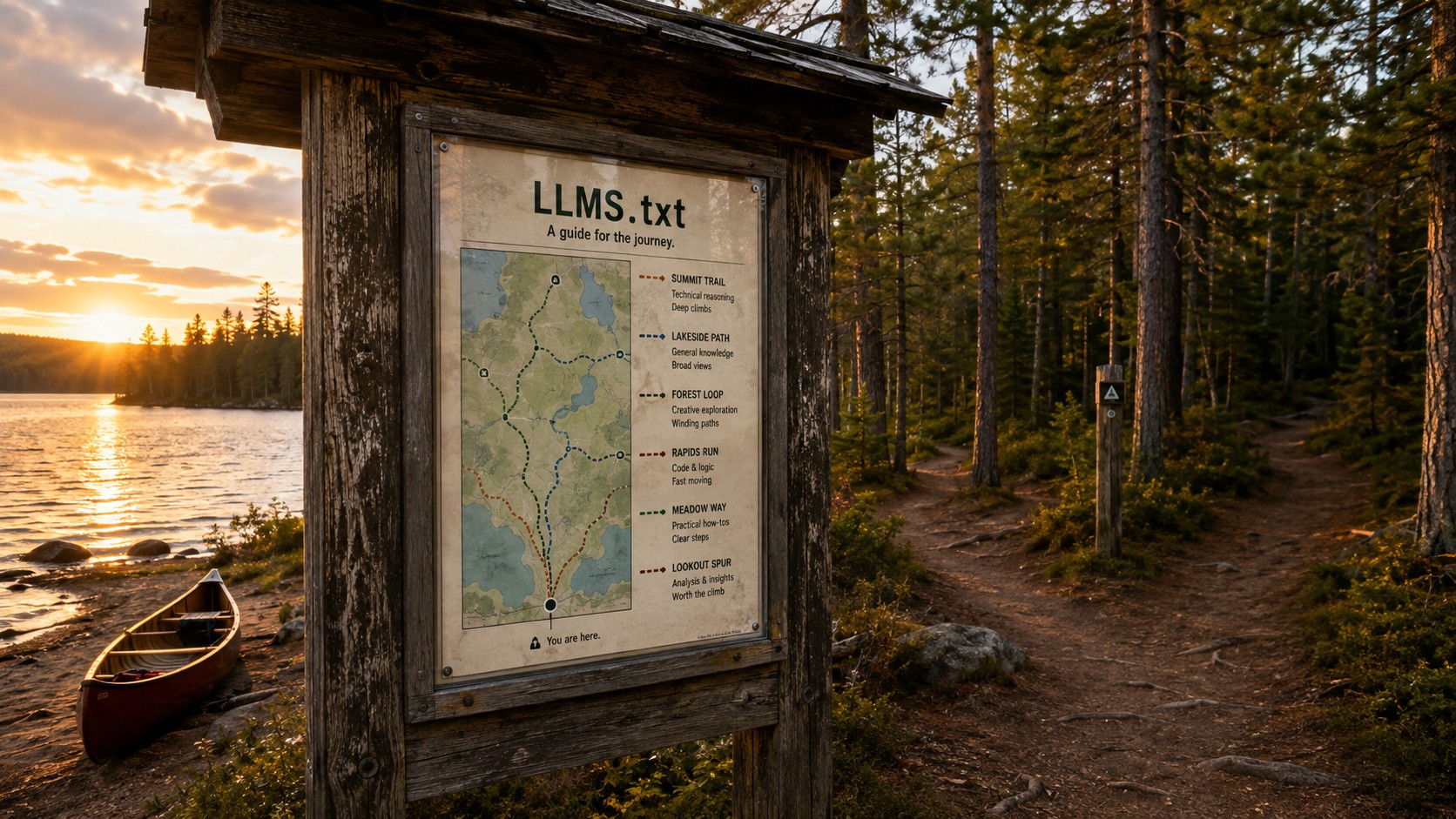
It's a single plain text file that lives at the root of your website, like this:
yourcompany.com/llms.txt
Inside it is a short, clean summary of your business written for machines rather than for visitors. Who you are, where you are, what you do, which pages matter, and how to reach you. No layout, no images, no menus. Just the facts, in order.
If you've heard of robots.txt, this is a cousin of that idea. Robots.txt tells crawlers where they're allowed to go. llms.txt tells them what they're looking at once they get there.
Another way to think about it: it's the one-page briefing you'd hand a new salesperson on their first day. Here's the company, here's what we sell, here's who we sell it to, here's the stuff you'll get asked about. You wouldn't hand that person your homepage and wish them luck.
What actually goes in one
Ours runs about 190 lines. The sections that do the most work:
- The basics. Legal name, founding year, address, phone, email. Boring, and the single most useful thing in the file.
- What you do. Your services, described the way a customer would describe them.
- Problems you solve. This one is worth the effort. Instead of listing "CMS migration services," you write the sentence a customer would actually say out loud: "Our website is stuck on an old version and the developer who built it is gone." Then you point that at the right page. It maps how people really ask questions to where the answer lives.
- Proof. A few real projects with real numbers. "Handles up to 179,000 monthly visitors" does more for you than "award-winning solutions" ever will.
- Recent writing. A short list of your latest articles, with dates, so a system reading it knows what's current.
Every line links to a real page on your site. Nothing in the file should be a claim you can't back up with a click.
The honest part: does it work yet?
llms.txt is a proposed convention, not a standard. Adoption is partial. Google has said publicly that it doesn't currently use these files, and most major crawlers ignore them today. Anyone promising you a traffic bump from adding one is getting ahead of the facts.
So why bother?
Three reasons, and none of them are magic.
First, it's cheap. This is a text file. It's an afternoon of writing, not a project.
Second, writing it forces a kind of clarity that's genuinely useful on its own. You cannot write a good llms.txt without deciding, in one sentence each, what you do and who it's for. Most sites have never been made to do that.
Third, and this is the real one: the work you do to write it is the same work that pays off in the places AI is already reading. Which brings us to the thing that actually matters right now.
Schema is still the bigger lever
If you only do one of these, do structured data.
Schema markup is the invisible code that labels your business details for machines, and unlike llms.txt, it's consumed today by Google, Bing, voice assistants, and the AI tools summarizing your industry. It's the established version of the same idea.
Think of llms.txt as low-cost preparation and schema as the thing already working. Do both if you can. Do schema first if you have to choose.
What we found doing our own
We published one at creativearc.com/llms.txt recently, partly to have an honest opinion about it before recommending it to anyone.
The most useful thing that came out of it had nothing to do with AI. When we sat down to write our address in the file, we discovered our own office address was written three different ways across our own website. Footer said one thing, our structured data said another, an internal document said a third. (And yes, that's a little embarrassing for a shop that does this professionally.)
That kind of inconsistency quietly works against you in local search, because those systems treat formatting variants as separate listings. We'd have kept right on missing it if we hadn't been forced to write the facts down in one place.
That's the pattern we'd expect for most sites. The file itself may or may not get read this year. The audit you do to write it will potentially find something.
If you want to try it
Two things you can do this week without calling anybody.
Open ChatGPT or Claude and ask about your business by name. Ask what services you offer, where you're located, who you serve. Read what comes back. If it's vague, dated, or describing a competitor, that's your answer about how legible your site currently is.
Then check whether you have structured data at all. Google's Rich Results Test and the Schema Markup Validator will both tell you in about a minute, for free.
If the results are underwhelming, that's fixable, and it's usually a small job rather than a redesign. Happy to take a look and tell you which of the two is worth your time. Just reach out!